Insid Out and Back Again Pdf
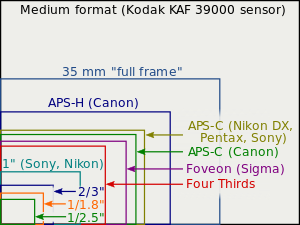
Comparative dimensions of sensor sizes
In digital photography, the image sensor format is the shape and size of the prototype sensor.
The image sensor format of a digital camera determines the angle of view of a particular lens when used with a item sensor. Considering the image sensors in many digital cameras are smaller than the 24 mm × 36 mm image expanse of full-frame 35 mm cameras, a lens of a given focal length gives a narrower field of view in such cameras.
Sensor size is frequently expressed every bit optical format in inches. Other measures are also used; encounter table of sensor formats and sizes below.
Lenses produced for 35 mm film cameras may mountain well on the digital bodies, but the larger prototype circle of the 35 mm organisation lens allows unwanted light into the camera body, and the smaller size of the image sensor compared to 35 mm film format results in cropping of the epitome. This latter effect is known every bit field-of-view crop. The format size ratio (relative to the 35 mm film format) is known every bit the field-of-view ingather gene, crop gene, lens factor, focal-length conversion factor, focal-length multiplier, or lens multiplier.
Sensor size and depth of field [edit]
3 possible depth-of-field comparisons between formats are discussed, applying the formulae derived in the article on depth of field. The depths of field of the three cameras may be the same, or different in either order, depending on what is held abiding in the comparison.
Considering a picture with the same subject distance and bending of view for two different formats:

and then the DOFs are in changed proportion to the accented discontinuity diameters and .


Using the same accented aperture bore for both formats with the "same picture" criterion (equal angle of view, magnified to same final size) yields the aforementioned depth of field. It is equivalent to adjusting the f-number inversely in proportion to ingather cistron – a smaller f-number for smaller sensors (this also ways that, when holding the shutter speed fixed, the exposure is changed by the aligning of the f-number required to equalise depth of field. But the discontinuity area is held constant, so sensors of all sizes receive the same total amount of light energy from the subject. The smaller sensor is then operating at a lower ISO setting, past the square of the ingather factor). This condition of equal field of view, equal depth of field, equal aperture diameter, and equal exposure time is known every bit "equivalence".[1]
And, we might compare the depth of field of sensors receiving the same photometric exposure – the f-number is fixed instead of the aperture bore – the sensors are operating at the aforementioned ISO setting in that example, merely the smaller sensor is receiving less total light, by the surface area ratio. The ratio of depths of field is so
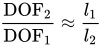
where and are the characteristic dimensions of the format, and thus is the relative crop factor between the sensors. It is this issue that gives rise to the common opinion that small sensors yield greater depth of field than big ones.


An alternative is to consider the depth of field given by the aforementioned lens in conjunction with different sized sensors (irresolute the angle of view). The modify in depth of field is brought near by the requirement for a different degree of enlargement to accomplish the same concluding epitome size. In this case the ratio of depths of field becomes
- .
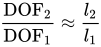
In practice, if applying a lens with a fixed focal length and a fixed discontinuity and made for an image circle to run across the requirements for a large sensor is to be adapted, without changing its physical properties, to smaller sensor sizes neither the depth of field nor the calorie-free gathering will change.

Sensor size, noise and dynamic range [edit]
Discounting photo response non-uniformity (PRNU) and dark noise variation, which are not intrinsically sensor-size dependent, the noises in an image sensor are shot noise, read noise, and dark noise. The overall signal to noise ratio of a sensor (SNR), expressed as signal electrons relative to rms noise in electrons, observed at the calibration of a single pixel, assuming shot dissonance from Poisson distribution of signal electrons and dark electrons, is

where is the incident photon flux (photons per 2nd in the area of a pixel), is the breakthrough efficiency, is the exposure time, is the pixel dark current in electrons per second and is the pixel read noise in electrons rms.[ii]


Each of these noises has a unlike dependency on sensor size.
Exposure and photon flux [edit]
Image sensor dissonance can be compared across formats for a given fixed photon flux per pixel expanse (the P in the formulas); this analysis is useful for a fixed number of pixels with pixel area proportional to sensor area, and fixed absolute aperture diameter for a stock-still imaging state of affairs in terms of depth of field, diffraction limit at the subject area, etc. Or it can exist compared for a fixed focal-plane illuminance, respective to a fixed f-number, in which example P is proportional to pixel surface area, independent of sensor area. The formulas above and below tin can be evaluated for either case.
Shot dissonance [edit]
In the above equation, the shot noise SNR is given past
- .
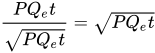
Apart from the quantum efficiency it depends on the incident photon flux and the exposure time, which is equivalent to the exposure and the sensor area; since the exposure is the integration time multiplied with the prototype airplane illuminance, and illuminance is the luminous flux per unit area. Thus for equal exposures, the signal to noise ratios of two different size sensors of equal breakthrough efficiency and pixel count volition (for a given final epitome size) be in proportion to the foursquare root of the sensor area (or the linear scale gene of the sensor). If the exposure is constrained past the need to achieve some required depth of field (with the same shutter speed) and then the exposures will be in inverse relation to the sensor area, producing the interesting result that if depth of field is a constraint, paradigm shot noise is not dependent on sensor area. For identical f-number lenses the signal to noise ratio increases as square root of the pixel area, or linearly with pixel pitch. As typical f-numbers for lenses for jail cell phones and DSLR are in the same range f/i.5-f/2 it is interesting to compare operation of cameras with small and big sensors. A skilful jail cell phone camera with typical pixel size one.i μm (Samsung A8) would have about 3 times worse SNR due to shot racket than a 3.7 μm pixel interchangeable lens camera (Panasonic G85) and 5 times worse than a 6 μm full frame camera (Sony A7 III). Taking into consideration the dynamic range makes the difference fifty-fifty more than prominent. Equally such the trend of increasing the number of "megapixels" in cell phone cameras during last 10 years was caused rather by marketing strategy to sell "more megapixels" than by attempts to better image quality.
Read noise [edit]
The read racket is the total of all the electronic noises in the conversion chain for the pixels in the sensor array. To compare information technology with photon noise, information technology must be referred back to its equivalent in photoelectrons, which requires the division of the noise measured in volts past the conversion proceeds of the pixel. This is given, for an active pixel sensor, by the voltage at the input (gate) of the read transistor divided by the charge which generates that voltage, . This is the inverse of the capacitance of the read transistor gate (and the attached floating diffusion) since capacitance .[3] Thus .
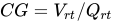


In general for a planar structure such equally a pixel, capacitance is proportional to area, therefore the read noise scales downward with sensor area, as long every bit pixel surface area scales with sensor area, and that scaling is performed past uniformly scaling the pixel.
Considering the signal to noise ratio due to read racket at a given exposure, the signal will scale every bit the sensor expanse along with the read noise and therefore read noise SNR will exist unaffected past sensor area. In a depth of field constrained situation, the exposure of the larger sensor volition exist reduced in proportion to the sensor surface area, and therefore the read racket SNR volition reduce as well.
Nighttime dissonance [edit]
Dark current contributes ii kinds of racket: dark showtime, which is just partly correlated between pixels, and the shot noise associated with nighttime offset, which is uncorrelated between pixels. Only the shot-noise component Dt is included in the formula to a higher place, since the uncorrelated part of the dark offset is difficult to predict, and the correlated or mean part is relatively easy to decrease off. The mean dark electric current contains contributions proportional both to the area and the linear dimension of the photodiode, with the relative proportions and scale factors depending on the design of the photodiode.[4] Thus in full general the dark noise of a sensor may be expected to ascent as the size of the sensor increases. However, in nearly sensors the mean pixel dark current at normal temperatures is small, lower than l e- per second,[5] thus for typical photographic exposure times dark current and its associated noises may be discounted. At very long exposure times, notwithstanding, it may be a limiting factor. And fifty-fifty at brusque or medium exposure times, a few outliers in the dark-current distribution may show upward as "hot pixels". Typically, for astrophotography applications sensors are cooled to reduce dark electric current in situations where exposures may exist measured in several hundreds of seconds.
Dynamic range [edit]
Dynamic range is the ratio of the largest and smallest recordable bespeak, the smallest beingness typically defined past the 'noise floor'. In the image sensor literature, the noise flooring is taken as the readout noise, so [6] (note, the read noise is the aforementioned quantity as referred to in the SNR calculation[two]).


Sensor size and diffraction [edit]
The resolution of all optical systems is limited past diffraction. One way of because the issue that diffraction has on cameras using different sized sensors is to consider the modulation transfer function (MTF). Diffraction is one of the factors that contribute to the overall arrangement MTF. Other factors are typically the MTFs of the lens, anti-aliasing filter and sensor sampling window.[7] The spatial cutting-off frequency due to diffraction through a lens aperture is
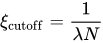
where λ is the wavelength of the light passing through the system and N is the f-number of the lens. If that aperture is circular, as are (approximately) most photographic apertures, and so the MTF is given by
![{\displaystyle \mathrm {MTF} \left({\frac {\xi }{\xi _{\mathrm {cutoff} }}}\right)={\frac {2}{\pi }}\left\{\cos ^{-1}\left({\frac {\xi }{\xi _{\mathrm {cutoff} }}}\right)-\left({\frac {\xi }{\xi _{\mathrm {cutoff} }}}\right)\left[1-\left({\frac {\xi }{\xi _{\mathrm {cutoff} }}}\right)^{2}\right]^{\frac {1}{2}}\right\}}](https://wikimedia.org/api/rest_v1/media/math/render/svg/2df679bc046c28caa3d3f26b8db34e88d924319e)
for and for [8] The diffraction based cistron of the system MTF will therefore scale according to and in turn co-ordinate to (for the aforementioned light wavelength).


In because the effect of sensor size, and its effect on the final prototype, the different magnification required to obtain the same size paradigm for viewing must be accounted for, resulting in an boosted scale gene of where is the relative ingather cistron, making the overall scale factor . Considering the three cases above:


For the 'aforementioned motion picture' conditions, aforementioned angle of view, subject area distance and depth of field, then the F-numbers are in the ratio , so the scale factor for the diffraction MTF is ane, leading to the conclusion that the diffraction MTF at a given depth of field is contained of sensor size.

In both the 'same photometric exposure' and 'same lens' weather condition, the F-number is non changed, and thus the spatial cutoff and resultant MTF on the sensor is unchanged, leaving the MTF in the viewed image to be scaled as the magnification, or inversely as the ingather factor.
Sensor format and lens size [edit]
It might be expected that lenses appropriate for a range of sensor sizes could be produced by just scaling the same designs in proportion to the crop gene.[9] Such an exercise would in theory produce a lens with the aforementioned F-number and bending of view, with a size proportional to the sensor ingather factor. In practice, simple scaling of lens designs is not always achievable, due to factors such as the non-scalability of manufacturing tolerance, structural integrity of glass lenses of dissimilar sizes and available manufacturing techniques and costs. Moreover, to maintain the aforementioned accented amount of information in an image (which can be measured equally the space bandwidth product[ten]) the lens for a smaller sensor requires a greater resolving power. The development of the 'Tessar' lens is discussed by Nasse,[11] and shows its transformation from an f/6.3 lens for plate cameras using the original three-grouping configuration through to an f/2.8 v.2 mm 4-element optic with eight extremely aspheric surfaces, economically manufacturable because of its small size. Its performance is 'improve than the all-time 35 mm lenses – but simply for a very pocket-size image'.
In summary, equally sensor size reduces, the accompanying lens designs will change, often quite radically, to take reward of manufacturing techniques fabricated available due to the reduced size. The functionality of such lenses can also take advantage of these, with extreme zoom ranges becoming possible. These lenses are oft very large in relation to sensor size, but with a small-scale sensor can be fitted into a compact package.
Small body means small lens and means pocket-sized sensor, so to keep smartphones slim and calorie-free, the smartphone manufacturers utilise a tiny sensor normally less than the 1/ii.iii" used in most span cameras. At one time only Nokia 808 PureView used a ane/i.2" sensor, almost three times the size of a i/2.3" sensor. Bigger sensors have the advantage of ameliorate image quality, merely with improvements in sensor technology, smaller sensors can attain the feats of earlier larger sensors. These improvements in sensor applied science permit smartphone manufacturers to use epitome sensors as small equally ane/4" without sacrificing also much prototype quality compared to upkeep point & shoot cameras.[12]
Agile area of the sensor [edit]
For calculating camera bending of view one should employ the size of active area of the sensor. Active surface area of the sensor implies an area of the sensor on which epitome is formed in a given fashion of the camera. The agile area may be smaller than the prototype sensor, and agile expanse can differ in different modes of operation of the same camera. Active area size depends on the aspect ratio of the sensor and aspect ratio of the output prototype of the photographic camera. The agile area size can depend on number of pixels in given mode of the photographic camera. The agile area size and lens focal length determines angles of view.[13]
Sensor size and shading furnishings [edit]
Semiconductor paradigm sensors tin can suffer from shading effects at large apertures and at the periphery of the image field, due to the geometry of the light cone projected from the exit pupil of the lens to a point, or pixel, on the sensor surface. The effects are discussed in particular by Catrysse and Wandell .[14] In the context of this discussion the nearly of import result from the above is that to ensure a total transfer of light free energy between two coupled optical systems such equally the lens' exit educatee to a pixel's photoreceptor the geometrical extent (too known every bit etendue or light throughput) of the objective lens / pixel system must be smaller than or equal to the geometrical extent of the microlens / photoreceptor organisation. The geometrical extent of the objective lens / pixel system is given past
- ,
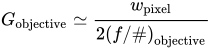
where wpixel is the width of the pixel and (f/#)objective is the f-number of the objective lens. The geometrical extent of the microlens / photoreceptor organization is given past
- ,
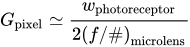
where westphotoreceptor is the width of the photoreceptor and (f/#)microlens is the f-number of the microlens.
Then to avert shading,
- , therefore


If wphotoreceptor / wpixel = ff , the linear fill factor of the lens, then the condition becomes

Thus if shading is to exist avoided the f-number of the microlens must be smaller than the f-number of the taking lens by at least a factor equal to the linear fill factor of the pixel. The f-number of the microlens is determined ultimately by the width of the pixel and its top in a higher place the silicon, which determines its focal length. In turn, this is determined past the height of the metallisation layers, besides known as the 'stack height'. For a given stack elevation, the f-number of the microlenses will increase as pixel size reduces, and thus the objective lens f-number at which shading occurs will tend to increment. This outcome has been observed in practice, equally recorded in the DxOmark commodity 'F-end blues'[15]
In order to maintain pixel counts smaller sensors will tend to have smaller pixels, while at the same time smaller objective lens f-numbers are required to maximise the amount of lite projected on the sensor. To combat the effect discussed above, smaller format pixels include engineering blueprint features to allow the reduction in f-number of their microlenses. These may include simplified pixel designs which require less metallisation, 'lite pipes' built within the pixel to bring its apparent surface closer to the microlens and 'back side illumination' in which the wafer is thinned to betrayal the rear of the photodetectors and the microlens layer is placed direct on that surface, rather than the front side with its wiring layers. The relative effectiveness of these stratagems is discussed past Aptina in some detail.[16]
Mutual prototype sensor formats [edit]
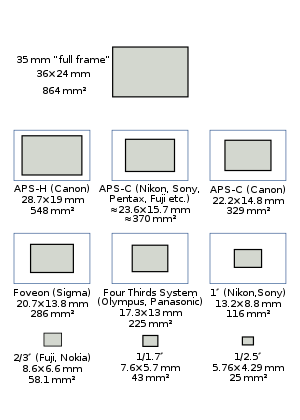
Sizes of sensors used in most electric current digital cameras relative to a standard 35 mm frame.
For interchangeable-lens cameras [edit]
Some professional person DSLRs, SLTs and mirrorless cameras use full-frame sensors, equivalent to the size of a frame of 35 mm film.
Most consumer-level DSLRs, SLTs and mirrorless cameras use relatively large sensors, either somewhat nether the size of a frame of APS-C film, with a crop factor of 1.5–one.vi; or 30% smaller than that, with a crop cistron of 2.0 (this is the Iv Thirds Organization, adopted past Olympus and Panasonic).
As of November 2013[update] at that place is just i mirrorless model equipped with a very small sensor, more typical of meaty cameras: the Pentax Q7, with a 1/1.7" sensor (4.55 crop factor). See Sensors equipping Compact digital cameras and photographic camera-phones section below.
Many different terms are used in marketing to draw DSLR/SLT/mirrorless sensor formats, including the following:
- 860 mm² area Full-frame digital SLR format, with sensor dimensions almost equal to those of 35 mm moving picture (36×24 mm) from Pentax, Panasonic, Leica, Nikon, Canon, Sony and announced in 2018 past Sigma as upcoming.
- 548 mm² expanse APS-H format for the high-end mirrorless SD Quattro H from Sigma (crop factor 1.35)
- 370 mm² area APS-C standard format from Nikon, Pentax, Sony, Fujifilm, Sigma (crop factor 1.5) (Actual APS-C moving picture is bigger, nonetheless.)
- 330 mm² area APS-C smaller format from Catechism (crop gene 1.6)
- 225 mm² surface area Micro Four Thirds Organisation format from Panasonic, Olympus, Black Magic and Polaroid (ingather gene two.0)
- 43 mm² area i/1.7" Pentax Q7 (4.55 crop factor)
Obsolescent and out-of-product sensor sizes include:
- 548 mm² area Leica's M8 and M8.2 sensor (crop factor one.33). Current Chiliad-serial sensors are effectively full-frame (crop cistron one.0).
- 548 mm² expanse Canon's APS-H format for high-speed pro-level DSLRs (crop factor ane.3). Current 1D/5D-series sensors are effectively full-frame (ingather factor one.0).
- 370 mm² area APS-C crop factor 1.5 format from Epson, Samsung NX, Konica Minolta.
- 286 mm² surface area Foveon X3 format used in Sigma SD-series DSLRs and DP-series mirrorless (ingather factor 1.7). Later models such as the SD1, DP2 Merrill and most of the Quattro serial utilize a crop cistron ane.five Foveon sensor; the even more than recent Quattro H mirrorless uses an APS-H Foveon sensor with a 1.35 ingather factor.
- 225 mm² expanse Four Thirds Organization format from Olympus (ingather cistron 2.0)
- 116 mm² expanse 1" Nikon CX format used in Nikon one series[17] and Samsung mini-NX series (crop cistron 2.vii)
- 30 mm² area 1/ii.3" original Pentax Q (5.6 crop factor). Current Q-serial cameras accept a crop factor of 4.55.
When full-frame sensors were starting time introduced, production costs could exceed 20 times the cost of an APS-C sensor. Only twenty full-frame sensors can be produced on an viii inches (twenty cm) silicon wafer, which would fit 100 or more APS-C sensors, and there is a pregnant reduction in yield due to the large expanse for contaminants per component. Additionally, full frame sensor fabrication originally required three separate exposures during the photolithography stage, which requires separate masks and quality control steps. Canon selected the intermediate APS-H size, since it was at the time the largest that could be patterned with a single mask, helping to control production costs and manage yields.[18] Newer photolithography equipment now allows unmarried-pass exposures for full-frame sensors, although other size-related product constraints remain much the same.
Due to the ever-irresolute constraints of semiconductor fabrication and processing, and because photographic camera manufacturers ofttimes source sensors from tertiary-party foundries, information technology is common for sensor dimensions to vary slightly within the same nominal format. For example, the Nikon D3 and D700 cameras' nominally full-frame sensors really measure out 36 × 23.9 mm, slightly smaller than a 36 × 24 mm frame of 35 mm moving-picture show. Equally another example, the Pentax K200D'due south sensor (made past Sony) measures 23.5 × xv.seven mm, while the contemporaneous K20D's sensor (made by Samsung) measures 23.4 × xv.vi mm.
Almost of these epitome sensor formats approximate the 3:2 attribute ratio of 35 mm film. Over again, the Four Thirds Organisation is a notable exception, with an aspect ratio of 4:iii every bit seen in well-nigh meaty digital cameras (see below).
Smaller sensors [edit]
Most sensors are made for photographic camera phones, compact digital cameras, and bridge cameras. Most image sensors equipping compact cameras have an aspect ratio of iv:3. This matches the aspect ratio of the popular SVGA, XGA, and SXGA brandish resolutions at the time of the outset digital cameras, allowing images to exist displayed on usual monitors without cropping.
As of December 2010[update] most compact digital cameras used small 1/2.3" sensors. Such cameras include Canon Powershot SX230 IS, Fuji Finepix Z90 and Nikon Coolpix S9100. Some older digital cameras (mostly from 2005–2010) used fifty-fifty smaller ane/2.5" sensors: these include Panasonic Lumix DMC-FS62, Catechism Powershot SX120 IS, Sony Cyber-shot DSC-S700, and Casio Exilim EX-Z80.
Equally of 2018 loftier-stop meaty cameras using i inch sensors that have near four times the area of those equipping common compacts include Catechism PowerShot G-series (G3 X to G9 10), Sony DSC RX100 series, Panasonic Lumix TZ100 and Panasonic DMC-LX15. Canon has APS-C sensor on its top model PowerShot G1 X Marker III.

For many years until Sep. 2011 a gap existed between compact digital and DSLR photographic camera sensor sizes. The x axis is a discrete set of sensor format sizes used in digital cameras, not a linear measurement axis.
Finally, Sony has the DSC-RX1 and DSC-RX1R cameras in their lineup, which have a full-frame sensor usually merely used in professional DSLRs, SLTs and MILCs.
Due to the size constraints of powerful zoom objectives, well-nigh current bridge cameras have 1/2.3" sensors, as small as those used in common more meaty cameras. As lens sizes are proportional to the image sensor size, smaller sensors enable large zoom amounts with moderate size lenses. In 2011 the loftier-end Fujifilm X-S1 was equipped with a much larger 2/three" sensor. In 2013–2014, both Sony (Cyber-shot DSC-RX10) and Panasonic (Lumix DMC-FZ1000) produced bridge cameras with i" sensors.
The sensors of camera phones are typically much smaller than those of typical compact cameras, assuasive greater miniaturization of the electrical and optical components. Sensor sizes of around one/6" are common in camera phones, webcams and digital camcorders. The Nokia N8'due south 1/1.83" sensor was the largest in a phone in late 2011. The Nokia 808 surpasses compact cameras with its 41 million pixels, 1/i.2" sensor.[19]
Medium-format digital sensors [edit]
The largest digital sensors in commercially available cameras are described as medium format, in reference to film formats of similar dimensions. Although the traditional medium format 120 film ordinarily had i side with 6 cm length (the other varying from 4.5 to 24 cm), the most common digital sensor sizes described beneath are approximately 48 mm × 36 mm (one.9 in × i.4 in), which is roughly twice the size of a Total-frame digital SLR sensor format.
Available CCD sensors include Phase Ane's P65+ digital dorsum with Dalsa'south 53.9 mm × xl.iv mm (2.12 in × ane.59 in) sensor containing lx.5 megapixels[20] and Leica's "S-System" DSLR with a 45 mm × 30 mm (i.8 in × 1.2 in) sensor containing 37-megapixels.[21] In 2010, Pentax released the 40MP 645D medium format DSLR with a 44 mm × 33 mm (1.7 in × i.three in) CCD sensor;[22] later models of the 645 series kept the same sensor size but replaced the CCD with a CMOS sensor. In 2016, Hasselblad announced the X1D, a 50MP medium-format mirrorless photographic camera, with a 44 mm × 33 mm (i.vii in × 1.3 in) CMOS sensor.[23] In tardily 2016, Fujifilm also announced its new Fujifilm GFX 50S medium format, mirrorless entry into the market, with a 43.8 mm × 32.9 mm (1.72 in × ane.30 in) CMOS sensor and 51.4MP. [24] [25]
Table of sensor formats and sizes [edit]
Sensor sizes are expressed in inches note considering at the time of the popularization of digital paradigm sensors they were used to replace video camera tubes. The common 1" exterior diameter circular video camera tubes have a rectangular photo sensitive area well-nigh 16 mm on the diagonal, so a digital sensor with a 16 mm diagonal size is a 1" video tube equivalent. The name of a 1" digital sensor should more than accurately be read as "one inch video camera tube equivalent" sensor. Current digital prototype sensor size descriptors are the video camera tube equivalency size, non the bodily size of the sensor. For example, a 1" sensor has a diagonal measurement of 16 mm.[26] [27]
Sizes are often expressed equally a fraction of an inch, with a one in the numerator, and a decimal number in the denominator. For case, 1/2.five converts to 2/5 every bit a simple fraction, or 0.4 as a decimal number. This "inch" system gives a result approximately 1.5 times the length of the diagonal of the sensor. This "optical format" measure goes back to the mode paradigm sizes of video cameras used until the late 1980s were expressed, referring to the outside diameter of the glass envelope of the video camera tube. David Pogue of The New York Times states that "the actual sensor size is much smaller than what the camera companies publish – virtually one-third smaller." For example, a camera advertising a 1/2.7" sensor does not take a sensor with a diagonal of 0.37"; instead, the diagonal is closer to 0.26".[28] [29] [30] Instead of "formats", these sensor sizes are often called types, equally in "1/2-inch-type CCD."
Due to inch-based sensor formats non being standardized, their exact dimensions may vary, just those listed are typical.[29] The listed sensor areas bridge more than a factor of 1000 and are proportional to the maximum possible collection of low-cal and image resolution (same lens speed, i.east., minimum F-number), but in do are not directly proportional to prototype noise or resolution due to other limitations. Come across comparisons.[31] [32] Moving-picture show format sizes are also included, for comparing. The awarding examples of phone or camera may not show the exact sensor sizes.
| Type | Diagonal (mm) | Width (mm) | Height (mm) | Aspect Ratio | Area (mm²) | Stops (expanse)[33] | Crop cistron[34] |
|---|---|---|---|---|---|---|---|
| 1/10" | 1.threescore | 1.28 | 0.96 | 4:three | 1.23 | -nine.46 | 27.04 |
| 1/8" | 2.00 | ane.60 | 1.20 | 4:3 | 1.92 | -8.81 | 21.65 |
| ane/half dozen" (Panasonic SDR-H20, SDR-H200) | 3.00 | 2.forty | 1.eighty | 4:3 | iv.32 | -7.64 | 14.14 |
| 1/iv"[35] | 4.50 | three.threescore | 2.70 | iv:three | 9.72 | -6.47 | 10.81 |
| 1/3.vi" (Nokia Lumia 720)[36] | five.00 | 4.00 | 3.00 | four:3 | 12.0 | -6.17 | 8.65 |
| 1/3.2" (iPhone 5)[37] | 5.68 | iv.54 | three.42 | 4:iii | xv.50 | -five.lxxx | seven.61 |
| ane/3.09" Sony EXMOR IMX351[38] | 5.82 | iv.66 | 3.5 | 4:3 | xvi.iii | -v.73 | 7.43 |
| Standard 8 mm film frame | 5.94 | 4.8 | 3.5 | 11:8 | 16.eight | -v.68 | 7.28 |
| 1/3" (iPhone 5S, iPhone half dozen, LG G3[39]) | 6.00 | 4.80 | 3.60 | iv:3 | 17.30 | -5.64 | 7.21 |
| 1/2.9" Sony EXMOR IMX322[xl] | 6.23 | iv.98 | 3.74 | 4:3 | 18.63 | -5.54 | half dozen.92 |
| 1/2.7" Fujifilm 2800 Zoom | 6.72 | five.37 | 4.04 | 4:3 | 21.70 | -5.32 | vi.44 |
| Super 8 mm film frame | 7.04 | 5.79 | iv.01 | 13:nine | 23.22 | -5.22 | vi.15 |
| 1/ii.5" (Nokia Lumia 1520, Sony Cyber-shot DSC-T5, iPhone XS[41]) | seven.18 | 5.76 | four.29 | 4:three | 24.70 | -5.13 | 6.02 |
| 1/2.three" (Pentax Q, Sony Cyber-shot DSC-W330, GoPro HERO3, Panasonic HX-A500, Google Pixel/Pixel+, DJI Phantom three[42]/Mavic 2 Zoom[43]), Nikon P1000/P900 | seven.66 | half-dozen.17 | four.55 | four:3 | 28.50 | -4.94 | 5.64 |
| 1/2.3" Sony Exmor IMX220[44] | 7.87 | 6.30 | 4.72 | 4:3 | 29.73 | -4.86 | v.49 |
| 1/2" (Fujifilm HS30EXR, Xiaomi Mi 9, OnePlus 7, Espros EPC 660, DJI Mavic Air two) | eight.00 | 6.40 | 4.80 | iv:3 | 30.70 | -4.81 | v.41 |
| 1/ane.8" (Nokia N8) (Olympus C-5050, C-5060, C-7070) | 8.93 | vii.18 | five.32 | 4:3 | 38.20 | -4.50 | 4.84 |
| 1/1.seven" (Pentax Q7, Canon G10, G15, Huawei P20 Pro, Huawei P30 Pro, Huawei Mate 20 Pro) | 9.50 | 7.lx | 5.lxx | iv:3 | 43.30 | -four.32 | 4.55 |
| 1/ane.six" (Fujifilm f200exr [1]) | 10.07 | 8.08 | 6.01 | iv:three | 48.56 | -4.fifteen | four.30 |
| 2/3" (Nokia Lumia 1020, Fujifilm X10, X20, XF1) | 11.00 | 8.eighty | 6.sixty | 4:3 | 58.10 | -3.89 | 3.93 |
| 1/1.33" (Samsung Galaxy S20 Ultra)[45] | 12 | nine.half-dozen | 7.two | iv:iii | 69.12 | -3.64 | 3.58 |
| Standard 16 mm motion picture frame | 12.70 | 10.26 | vii.49 | 11:8 | 76.85 | -3.49 | 3.41 |
| 1/1.2" (Nokia 808 PureView) | 13.33 | 10.67 | 8.00 | 4:3 | 85.33 | -iii.34 | 3.24 |
| 1/1.12" (Xiaomi Mi xi Ultra) | 14.29 | eleven.43 | 8.57 | 4:3 | 97.96 | ??? | iii.03 |
| Blackmagic Pocket Cinema Photographic camera & Blackmagic Studio Photographic camera | 14.32 | 12.48 | seven.02 | xvi:9 | 87.6 | -iii.30 | 3.02 |
| Super 16 mm picture frame | fourteen.54 | 12.52 | 7.41 | 5:3 | 92.fourscore | -3.22 | ii.97 |
| 1" Nikon CX, Sony RX100 and RX10 and ZV1, Samsung NX Mini | 15.86 | thirteen.twenty | 8.80 | three:two | 116 | -two.89 | 2.72 |
| 1" Digital Bolex d16 | 16.00 | 12.fourscore | 9.60 | iv:3 | 123 | -2.81 | 2.70 |
| 1.1" Sony IMX253[46] | 17.46 | 14.10 | 10.30 | xi:8 | 145 | -2.57 | 2.47 |
| Blackmagic Movie theatre Camera EF | 18.13 | 15.81 | eight.88 | 16:9 | 140 | -ii.62 | two.38 |
| Blackmagic Pocket Cinema Photographic camera 4K | 21.44 | 18.96 | 10 | 19:10 | 190 | -2.19 | ii.01 |
| Iv Thirds, Micro Four Thirds ("4/3", "m4/3") | 21.lx | 17.30 | 13 | 4:3 | 225 | -i.94 | 2.00 |
| Blackmagic Production Camera/URSA/URSA Mini 4K | 24.23 | 21.12 | 11.88 | sixteen:9 | 251 | -1.78 | 1.79 |
| 1.five" Canon PowerShot G1 X Marking Ii | 23.36 | xviii.lxx | xiv | 4:3 | 262 | -1.72 | 1.85 |
| "35mm" 2 Perf Techniscope | 23.85 | 21.95 | nine.35 | seven:3 | 205.23 | -2.07 | 1.81 |
| original Sigma Foveon X3 | 24.ninety | 20.lxx | xiii.80 | three:2 | 286 | -1.60 | 1.74 |
| Blood-red DRAGON 4.5K (RAVEN) | 25.50 | 23.00 | 10.eighty | 19:9 | 248.4 | -1.80 | 1.66 |
| "Super 35mm" 2 Perf | 26.58 | 24.89 | ix.35 | viii:3 | 232.vii | -ane.89 | 1.62 |
| Canon EF-S, APS-C | 26.82 | 22.30 | 14.ninety | 3:two | 332 | -ane.38 | 1.61 |
| Standard 35 mm motion-picture show frame (movie) | 27.20 | 22.0 | sixteen.0 | 11:8 | 352 | -i.xxx | 1.59 |
| Blackmagic URSA Mini/Pro iv.6K | 29 | 25.34 | 14.25 | sixteen:ix | 361 | -1.26 | one.49 |
| APS-C (Sony α, Sony E, Nikon DX, Pentax K, Samsung NX, Fuji X) | 28.2–28.4 | 23.vi–23.7 | 15.60 | 3:two | 368–370 | -1.23 to -1.22 | 1.52–ane.54 |
| Super 35 mm movie 3 perf | 28.48 | 24.89 | 13.86 | 9:5 | 344.97 | -1.32 | one.51 |
| RED DRAGON 5K S35 | 28.9 | 25.six | thirteen.5 | 17:nine | 345.six | -1.32 | one.49 |
| Super 35mm film four perf | 31.11 | 24.89 | 18.66 | 4:iii | 464 | -0.ninety | 1.39 |
| Catechism APS-H | 33.50 | 27.ninety | 18.60 | three:ii | 519 | -0.74 | 1.29 |
| ARRI ALEV Three (ALEXA SXT, ALEXA MINI, AMIRA), Ruby-red HELIUM 8K S35 | 33.80 | 29.90 | xv.77 | 17:9 | 471.52 | -0.87 | 1.28 |
| RED DRAGON 6K S35 | 34.50 | 30.vii | 15.8 | 35:18 | 485.06 | -0.83 | 1.25 |
| 35 mm motion picture full-frame, (Canon EF, Nikon FX, Pentax K-1, Sony α, Sony Iron, Leica M) | 43.1–43.three | 35.eight–36 | 23.9–24 | three:2 | 856–864 | 0 | i.0 |
| ARRI ALEXA LF | 44.71 | 36.seventy | 25.54 | 13:9 | 937.32 | +0.12 | 0.96 |
| RED MONSTRO 8K VV, Panavision Millenium DXL2 | 46.31 | 40.96 | 21.60 | 17:9 | 884.74 | +0.03 | 0.93 |
| Leica S | 54 | 45 | 30 | 3:2 | 1350 | +0.64 | 0.80 |
| Pentax 645D, Hasselblad X1D-50c, CFV-50c, Fuji GFX 50S [47] [48] | 55 | 43.eight | 32.9 | 4:3 | 1452 | +0.75 | 0.78 |
| Standard 65/70 mm motion picture frame | 57.30 | 52.48 | 23.01 | 7:3 | 1208 | +0.48 | 0.76 |
| ARRI ALEXA 65 | 59.86 | 54.12 | 25.58 | xix:nine | 1384.39 | +0.68 | 0.72 |
| Kodak KAF 39000 CCD[49] | 61.xxx | 49 | 36.lxxx | 4:iii | 1803 | +ane.06 | 0.71 |
| Leaf AFi x | 66.57 | 56 | 36 | 14:nine | 2016 | +1.22 | 0.65 |
| Medium-format (Hasselblad H5D-60)[50] | 67.08 | 53.7 | 40.two | 4:3 | 2159 | +1.32 | 0.65 |
| Phase One P 65+, IQ160, IQ180 | 67.40 | 53.xc | xl.40 | four:3 | 2178 | +1.33 | 0.64 |
| Medium-format six×4.5 cm (also called 645 format) | 70 | 42 | 56 | 3:4 | 2352 | +one.44 | 0.614 |
| Medium-format 6×6 cm | 79 | 56 | 56 | 1:1 | 3136 | +1.86 | 0.538 |
| IMAX film frame | 87.91 | 70.41 | 52.63 | iv:3 | 3706 | +2.10 | 0.49 |
| Medium-format six×7 cm | 89.6 | seventy | 56 | 5:4 | 3920 | +2.18 | 0.469 |
| Medium-format half dozen×8 cm | 94.4 | 76 | 56 | 3:iv | 4256 | +ii.30 | 0.458 |
| Medium-format 6×9 cm | 101 | 84 | 56 | 3:2 | 4704 | +2.44 | 0.43 |
| Large-format film four×v inch | 150 | 121 | 97 | 5:4 | 11737 | +3.76 | 0.29 |
| Large-format film 5×7 inch | 210 | 178 | 127 | vii:5 | 22606 | +iv.71 | 0.238 |
| Large-format film 8×ten inch | 300 | 254 | 203 | 5:4 | 51562 | +five.90 | 0.143 |
See also [edit]
- Full-frame digital SLR
- Sensor size and angle of view
- 35 mm equivalent focal length
- Movie format
- Digital versus flick photography
- List of big sensor interchangeable-lens video cameras
- List of sensors used in digital cameras
- Angle of view
- Crop factor
- Field of view
Notes and references [edit]
- ^ "What is equivalence and why should I care?". DP Review. 2014-07-07. Retrieved 2017-05-03 .
- ^ a b Fellers, Thomas J.; Davidson, Michael W. "CCD Noise Sources and Signal-to-Dissonance Ratio". Hamamatsu Corporation. Retrieved 20 November 2013.
- ^ Aptina Imaging Corporation. "Leveraging Dynamic Response Pixel Engineering to Optimize Inter-scene Dynamic Range" (PDF). Aptina Imaging Corporation. Retrieved 17 December 2011.
- ^ Loukianova, Natalia V.; Folkerts, Hein Otto; Maas, Joris P. V.; Verbugt, Joris P. V.; Daniël West. E. Mierop, Adri J.; Hoekstra, Willem; Roks, Edwin and Theuwissen, Albert J. P. (January 2003). "Leakage Electric current Modeling of Exam Structures for Characterization of Nighttime Electric current in CMOS Prototype Sensors" (PDF). IEEE Transactions on Electron Devices. 50 (one): 77–83. Bibcode:2003ITED...fifty...77L. doi:10.1109/TED.2002.807249. Retrieved 17 Dec 2011.
{{cite journal}}: CS1 maint: multiple names: authors list (link) - ^ "Nighttime Count". Apogee Imaging Systems. Retrieved 17 December 2011.
- ^ Kavusi, Sam; El Gamal, Abbas (2004). Blouke, Morley M; Sampat, Nitin; Motta, Ricardo J (eds.). "Quantitative Study of High Dynamic Range Prototype Sensor Architectures" (PDF). Proc. Of SPIE-IS&T Electronic Imaging. Sensors and Photographic camera Systems for Scientific, Industrial, and Digital Photography Applications Five. 5301: 264–275. Bibcode:2004SPIE.5301..264K. doi:10.1117/12.544517. S2CID 14550103. Retrieved 17 Dec 2011.
- ^ Osuna, Rubén; García, Efraín. "Practice Sensors "Outresolve" Lenses?". The Luminous Mural. Archived from the original on 2 January 2010. Retrieved 21 December 2011.
- ^ Boreman, Glenn D. (2001). Modulation Transfer Function in Optical and Electro-Optical Systems. SPIE Press. p. 120. ISBN978-0-8194-4143-0.
- ^ Ozaktas, Haldun G; Urey, Hakan; Lohmann, Adolf W. (1994). "Scaling of diffractive and refractive lenses for optical computing and interconnections". Applied Eyes. 33 (17): 3782–3789. Bibcode:1994ApOpt..33.3782O. doi:10.1364/AO.33.003782. hdl:11693/13640. PMID 20885771.
- ^ Goodman, Joseph W (2005). Introduction to Fourier optics, tertiary edition. Greenwood Hamlet, Colorado: Roberts and Visitor. p. 26. ISBN978-0-9747077-2-3.
- ^ Nasse, H. H. "From the Series of Articles on Lens Names: Tessar" (PDF). Carl Zeiss AG. Archived from the original (PDF) on 13 May 2012. Retrieved 19 Dec 2011.
- ^ Simon Well-baked (21 March 2013). "Camera sensor size: Why does it matter and exactly how large are they?". Retrieved January 29, 2014.
- ^ Stanislav Utochkin. "Specifying active surface area size of the image sensor". Retrieved May 21, 2015.
- ^ Catrysse, Peter B.; Wandell, Brian A. (2005). "Roadmap for CMOS image sensors: Moore meets Planck and Sommerfeld" (PDF). Proceedings of the International Society for Optical Engineering. Digital Photography. 5678 (1): ane. Bibcode:2005SPIE.5678....1C. CiteSeerXx.1.1.lxxx.1320. doi:10.1117/12.592483. S2CID 7068027. Archived from the original (PDF) on thirteen Jan 2015. Retrieved 29 Jan 2012.
- ^ DxOmark. "F-stop dejection". DxOMark Insights . Retrieved 29 January 2012.
- ^ Aptina Imaging Corporation. "An Objective Look at FSI and BSI" (PDF). Aptina Applied science White Paper . Retrieved 29 January 2012.
- ^ "Nikon unveils J1 small sensor mirrorless camera as part of Nikon 1 system", Digital Photography Review .
- ^ "Canon's Total Frame CMOS Sensors" (PDF) (Printing release). 2006. Archived from the original (PDF) on 2012-x-28. Retrieved 2013-05-02 .
- ^ http://europe.nokia.com/PRODUCT_METADATA_0/Products/Phones/8000-series/808/Nokia808PureView_Whitepaper.pdf Nokia PureView imaging technology whitepaper
- ^ "The Phase One P+ Production Range". PHASE 1. Archived from the original on 2010-08-12. Retrieved 2010-06-07 .
- ^ "Leica S2 with 56% larger sensor than full frame" (Press release). Leica. 2008-09-23. Retrieved 2010-06-07 .
- ^ "Pentax unveils 40MP 645D medium format DSLR" (Press release). Pentax. 2010-03-10. Retrieved 2010-12-21 .
- ^ Johnson, Allison (2016-06-22). "Medium-format mirrorless: Hasselblad unveils X1D". Digital Photography Review. Retrieved 2016-06-26 .
- ^ "Fujifilm announces evolution of new medium format "GFX" mirroless camera system" (Press release). Fujifilm. 2016-09-19.
- ^ "Fujifilm'south Medium Format GFX 50S to Send in February for $vi,500". 2017-01-19.
- ^ Staff (7 October 2002). "Making (some) sense out of sensor sizes". Digital Photography Review. Digital Photography Review. Retrieved 29 June 2012.
- ^ Staff. "Prototype Sensor Format". Imaging Glossary Terms and Definitions. SPOT IMAGING SOLUTIONS. Archived from the original on 26 March 2015. Retrieved 3 June 2015.
- ^ Pogue, David (2010-12-22). "Small Cameras With Big Sensors, and How to Compare Them". The New York Times.
- ^ a b Bockaert, Vincent. "Sensor Sizes: Camera Organisation: Glossary: Larn". Digital Photography Review. Archived from the original on 2013-01-25. Retrieved 2012-04-09 .
- ^ "Making (Some) sense out of sensor sizes".
- ^ Camera Sensor Ratings DxOMark
- ^ Imaging-resource: Sample images Comparometer Imaging-resource
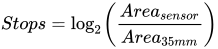
- ^ Defined here every bit the equivalent number of stops lost (or gained, if positive) due to the area of the sensor relative to a total 35 frame (36×24mm). Computed as
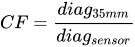
- ^ Defined here as the ratio of the diagonal of a full 35 frame to that of the sensor format, that is .
- ^ "Unravelling Sensor Sizes – Photograph Review". www.photoreview.com.au . Retrieved 2016-09-22 .
- ^ Nokia Lumia 720 – Full phone specifications, GSMArena.com, February 25, 2013, retrieved 2013-09-21
- ^ Photographic camera sensor size: Why does information technology matter and exactly how big are they?, Gizmag, March 21, 2013, retrieved 2013-06-xix
- ^ "Diagonal 5.822 mm (Type one/3.09) 16Mega-Pixel CMOS Image Sensor with Square Pixel for Color Cameras" (PDF). Sony. Retrieved 16 October 2019.
- ^ Comparing of iPhone Specs, PhoneArena
- ^ "Diagonal 6.23 mm (Blazon 1/ii.9) CMOS Image Sensor with Square Pixel for Colour Cameras" (PDF). Sony. 2015. Retrieved 3 April 2019.
- ^ "iPhone XS Max teardown reveals new sensor with more focus pixels". Digital Photography Review. 27 September 2018. Retrieved ane March 2019.
- ^ "Phantom 3 Professional person - Let your inventiveness fly with a 4K camera in the sky. - DJI". DJI Official . Retrieved 2019-12-01 .
- ^ "DJI - The Earth Leader in Camera Drones/Quadcopters for Aeriform Photography". DJI Official . Retrieved 2019-12-01 .
- ^ "Diagonal vii.87mm (Blazon i/2.3) xx.7M Pixel CMOS Image Sensor with Square Pixel for Color Cameras" (PDF). Sony. September 2014. Retrieved 3 Apr 2019.
- ^ "Samsung officially unveils 108MP ISOCELL Vivid HMX mobile camera sensor". Digital Photography Review. Aug 12, 2019. Retrieved xvi Feb 2021.
- ^ "Diagonal 17.six mm (Blazon i.one) Approx. 12.37M-Constructive Pixel Monochrome and Color CMOS Image Sensor" (PDF). Sony. March 2016. Retrieved 3 Apr 2019.
- ^ "Hasselblad X1D-II 50c Datasheet" (PDF). Hasselblad. 2019-06-01. Retrieved 2022-04-09 .
- ^ "GFX 50s Specifications". Fujifilm. Jan 17, 2019. Retrieved 2022-04-09 .
- ^ KODAK KAF-39000 Image SENSOR, DEVICE PERFORMANCE SPECIFICATION (PDF), KODAK, April 30, 2010, retrieved 2014-02-09
- ^ Hasselblad H5D-sixty medium-format DSLR photographic camera, B&H Photograph VIDEO, retrieved 2013-06-19
External links [edit]
- Eric Fossum: Photons to Bits and Beyond: The Science & Technology of Digital, Oct. 13, 2011 (YouTube Video of lecture)
- Joseph James: Equivalence at Joseph James Photography
- Simon Tindemans: Alternative photographic parameters: a format-independent approach at 21stcenturyshoebox
- Compact Camera Loftier ISO modes: Separating the facts from the hype at dpreview.com, May 2007
- The all-time compromise for a compact camera is a sensor with six million pixels or meliorate a sensor with a pixel size of >3μm at 6mpixel.org
- [2] at hasselblad.com
Source: https://en.wikipedia.org/wiki/Image_sensor_format
0 Response to "Insid Out and Back Again Pdf"
Post a Comment